From First Call to Forever Support: The Real Lifecycle of a Premium Partnership
When you look at a generic “Customer Onboarding Process” chart, it looks incredibly neat. A straight line with little icons like Brand Awareness, Feature Introduction, and Regular Check-ins.
But in the real world of scaling a business, that transition doesn’t happen in a vacuum. It happens in the middle of active operations, where you are managing clients, closing deals, and driving the company forward all at the same time. Bringing an operator into your ecosystem isn’t about halting your momentum to train someone from scratch; it is about integrating a seamless system into a business that is already running fast.
Over the years, I’ve learned that a premium partnership isn’t just about setting up a software tool. It’s a journey of building trust, handing over the keys safely, and establishing long-term, proactive care.
If we mapped that corporate timeline graphic onto a real, premium human partnership, here is what the story actually looks like—and the advice I give to founders navigating it.
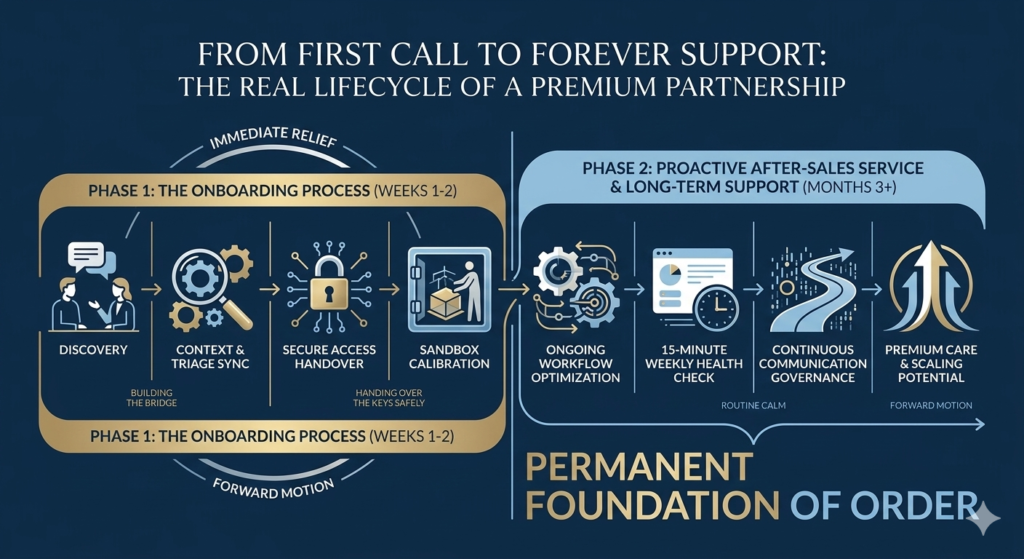
Phase 1: Breaking the Chaos (The Onboarding Stage)
The first half of our timeline is about building a secure bridge while the business keeps moving at full speed.
01 / The Realization (Brand Awareness)
Before a founder ever reaches out to me, they experience the classic friction of rapid growth. The business is expanding, but the infrastructure behind it is starting to stretch. You might notice that your inbox takes longer to clear, client tracking files need manual updates, or workflows are being held together by memory rather than a system. My advice to founders here is simple: Hitting an operational ceiling is a normal sign of success, not a failure. It just means your current momentum has outgrown your current tools.
02 / The Honest Diagnostic (First Customer Interaction)
Our very first call isn’t a slick sales pitch. It’s a transparent, sometimes messy diagnostic conversation. I ask targeted questions to find exactly where the information is leaking. My favorite part of this stage is watching a founder’s shoulders visibly drop when they realize they don’t have to perform for me—they just have to tell me where it hurts.
03 / The Secure Handshake (Welcome Message & Handover)
The moment a client signs, the first logistical step is the access handover. But a premium service means protecting your data. I never let clients text me passwords or dump logins into an unsecure email thread. We set up an encrypted credential manager on day one. It’s a small detail, but it sets the tone: we treat your business with absolute institutional discipline from hour one.
04 / The Sandbox Calibration (Onboarding with First-Time User)
Week one is what I call the “Sandbox Phase.” I step quietly into the live environment. To protect the founder’s voice, I run a strict Draft and Approve protocol. Every client update, vendor dispatch, or email reply is drafted by me and staged for a quick “yes/no” approval from the founder. It prevents mistakes, calibrates my tone to match theirs perfectly, and builds absolute trust.
Phase 2: Protecting Your Peace (The After-Sales Service)
Onboarding gets me into the business, but after-sales service is how I care for the client over the next six, twelve, or twenty-four months. This is where we move from just fixing immediate problems to proactively guarding the founder’s mental clarity.
05 / Restructuring the Engine (Feature Introduction)
Once I am inside the system, my long-term after-sales optimization begins. I look past the basic daily tasks and start cleaning up the database architecture and CRM pipelines. I strip away the over-engineered app bloat and centralize the business into a single source of truth. My advice to teams here: Software won’t save you. Simple, low-friction systems will.
06 / Setting the Rhythm (First Check-In)
At the end of our integration phase, we hold our first formal health check. We look at the newly built tracking dashboards, ensure the noise has quieted down, and map out the next 30 days. This milestone transitions us out of “setup mode” and into our permanent, calm operational rhythm.
07 / Anticipating the Next Turn (Product Promotion)
In a high-end service, “after-sales care” means never forcing the client to tell you what to do next. Once the core day-to-day is stable, I proactively look for areas to lift the business higher. I start drafting repeatable SOPs for their expanding team, refining vendor checklists, or streamlining customer success pipelines to protect their client retention. I expand my value so the founder can stay focused on macro growth.
08 / The 15-Minute Shield (Regular Check-Ins)
The ultimate, ongoing ritual of our partnership. We establish a rigid, 15-minute weekly check-in. We never use this live time to read out boring status lists—the dashboard handles that asynchronously. Instead, we scan our metrics, immediately triage active bottlenecks, assign single owners to roadblocks, and get off the call.
Shifting from Friction to Freedom
The true baseline of a successful company isn’t measured by how hard the founder works, but by how smoothly the business operates when the founder steps away.
Moving along this timeline—from that first introductory call to a permanent, ongoing after-sales partnership—is ultimately about business maturity. It marks the transition from running a frantic daily hustle to commanding a structured, automated asset.
When you anchor your business with an operator who continuously cleans the gears behind the scenes, you aren’t just offloading an inbox or a calendar. You are removing the invisible friction that slows down your growth, creating the quiet environment you need to build what’s next.