The Fifteen-minute Weekly Operations Check-in
We have all been trapped in the ninety-minute “status update” meeting. It usually happens on a Monday or Tuesday morning. The team sits in a circle or joins a Zoom grid, and one by one, everyone recites a list of the tasks they completed last week and the tasks they hope to complete this week.
It feels like productivity, but it is actually a symptom of an operational leak.
When a business is scaling past the point where the founder can keep everything in their head, communication protocols have to change. If your team needs an hour and a half just to tell each other what they are working on, it means your day-to-day documentation is failing. It means your project management system isn’t holding the source of truth, so you are using human bandwidth to sync data manually.
Over the last seven years of managing workflows across international remote teams, logistics networks, and scaling agencies, I have found that the healthiest teams don’t collaborate more—they sync more efficiently.
The antidote to meeting bloat is the 15-minute weekly operations check-in. Here is the exact blueprint for how to build and run it.
The Rule of Asynchronous Preparation
A live meeting is the most expensive way to extract status updates. The 15-minute sync only works if 90% of the information flow happens before anyone presses “Join Call.”
By default, the team must update their respective project pipelines, tracking sheets, or CRM milestones twenty-four hours before the meeting. If a task is done, the ticket is moved. If a shipment is delayed, the logistics log reflects it.
The meeting itself is not for reporting data. It is for resolving friction.
The 3-Part Agile Agenda
To keep the timeline strictly under fifteen minutes, the agenda must be rigid, clear, and focused entirely on operational milestones. We split the time into three distinct five-minute blocks:
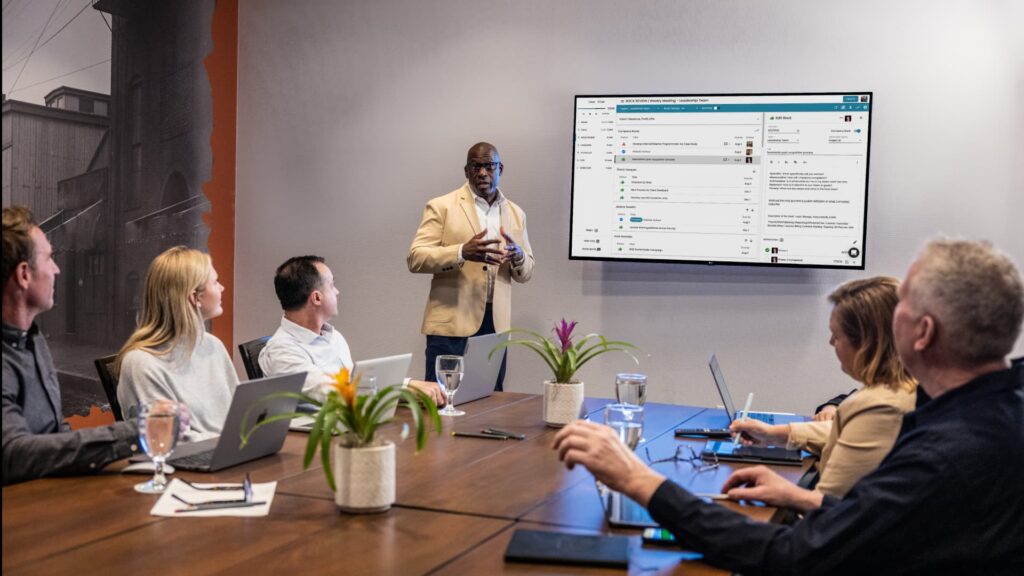
- 01 / The Dashboard Scan (Minutes 1–5): The operator shares their screen and walks through the core business metrics and project milestones. We do not discuss how the work was done. We simply look at the traffic lights: Is it green (on schedule), yellow (at risk), or red (delayed)?
- 02 / The Roadblock Triage (Minutes 5–10): This is where the value lies. Each team member brings their single biggest bottleneck. For a logistics business, it might be a customs hold-up in a different region; for an agency, it might be an onboarding delay with a key account. We state the roadblock, assign an owner to fix it, and move on. We do not problem-solve live.
- 03 / Bandwidth & Cross-Functional Alignment (Minutes 10–15): The final five minutes are reserved for adjusting resource allocation. If one project thread is hitting a wall, we realign the team dynamic to support it, ensuring that cross-vendor deadlines remain legible and protected.
The Role of the Operational Partner
For a founder, running this level of meeting governance while simultaneously trying to think about macro business strategy is exhausting. It shouldn’t be the founder’s job to gatekeep the clock, track the action items, or enforce the asynchronous preparation.
That is where a calm, integrated team operator comes in. My role during these rituals isn’t just to take minutes; it’s to build the rails. I design the dashboard structure, hold the team accountable to updating their data beforehand, synthesize the strategic decisions, and immediately transition the roadblocks into clean tracking workflows the moment the call ends.
When you transition from a “talking meeting” to an “operational check-in,” you give your team their hours back. More importantly, you preserve the founder’s decision quality for the things that actually move the business forward.
Structure doesn’t add noise to a team—it removes it.